
Root Canal Treatment
When the nerve of a tooth dies, it is
necessary to remove the
compromised nerve contents. Otherwise, it will cause an infection and
possibly fever, swelling and an abscess (collection of pus).
Different teeth have different numbers of
nerve (or root)
canals. An incisor might only have 1 nerve canal whilst a molar could
have as many as 4. Treatment complexity increases (as those the number
of visits required) with the number of root canals.
Surgery is sometimes required to save badly
compromised teeth. Such procedures include:
- Apisectomies: In this procedure, the tip
or apex of the root is
surgically removed along with the surrounding infection to allow the
bone to heal right up to the amputated root.
- Root resection: This is when an entire
root of a multi-rooted molar tooth is removed to save the remaining
tooth.
- Hemisection: Up to half the tooth might
be removed here to
save the rest. The remaining tooth structure can then be restored and
tooth loss minimised.
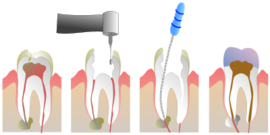
Sealed root
canal: All root filled molar teeth should be restored with a
crown
What are the benefits of Root
Canal Treatment?
Root Canal Treatment saves a tooth
that would otherwise be
extracted. Although the pulp has been removed, the tooth is still
anchored in the bone and can be used for biting and chewing.
What to expect during your appointment
The process of removing
the infected nerve contents (or Root Canal Treatment) normally takes 2
or 3 visits and involves cleaning the root canals with special
instruments called files and eventually filling the canals with a
biocompatible sealer. The tooth is then ready for a permanent
restoration.
Root Canal Treatment can sometimes be
completed in one visit but
often several visits are needed. Back teeth usually require more time
for treatment because they have more canals and are harder to reach.
During Root Canal Treatment, X-rays need to
be taken at each stage to assess the lengths and positions of the
canals.
Read
more about Root Canal Treatment here
When can I resume my normal activities?
Most patients can
go back to their normal daily activities on the same day. However be
careful not to use treated tooth to bite or chew until you have had it
capped with a crown. The unrestored tooth is vulnerable, so you should
see get it fully restored as soon as possible.
Is it painful?
Most patients do not experience discomfort
during the procedure. There may be some sensitivity with treated teeth
for a few days. Do consult your dentist if this persists.








 EMF
EMF
 Tel: +65 6226 2296
SMS/Whatsapp: +65 9298 7982 Email:
service.adc@outlook.com
Tel: +65 6226 2296
SMS/Whatsapp: +65 9298 7982 Email:
service.adc@outlook.com


