
Veneers
What are Veneers?
When our front teeth are chipped or discoloured, it may be necessary to
place a thin restoration over the front surface to hide these
discrepancies.
These thin sheets are called veneers
and can be made of
composite or porcelain. They only require minimal tooth preparation and
therefore conserve as much natural tooth structure as possible.
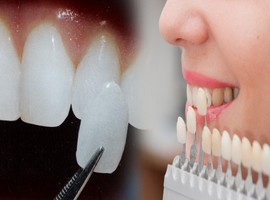
Veneers are relatively new dental
restorations and their success
can be attributed to advances in dental adhesives which allow them to
be fixed with great strength and security to teeth.
If the discrepancy is too great or the
biting force too large, a crown
may have to be made instead.
What to expect during your appointment
- During consultation, your dentist will examine your teeth and
determine if a veneer is required.
- In some instances the dentist may need to
shave of a little of the front of the tooth's surface before placing
the veneer on the tooth. An impression or mould of
the tooth is then made.
- While the veneer is
being made by the dental laboratory, you will be given a temporary
veneer.
- Once the veneer is
ready in about a week, the dentist will check if the colour and fit of
the teeth is alright. If it is satisfactory, the veneer
will then be cemented on to the tooth.
When can I resume my normal activities?
Most patients can go back to their normal daily activities within 2
hours.
Is it painful?
It is a totally painless procedure.
Taking care of your veneer?
- Do maintain your veneer by brushing daily to keep
it clean.
- Veneers may crack or chip over time like
natural teeth so visit your dentist regularly for a check up.
- You must be careful not to bite on hard
foods like ice, hard chocolate or bones. If there are any cracks or
chips on the veneer you may need to replace it.







 EMF
EMF
 Tel: +65 6226 2296
SMS/Whatsapp: +65 9298 7982 Email:
service.adc@outlook.com
Tel: +65 6226 2296
SMS/Whatsapp: +65 9298 7982 Email:
service.adc@outlook.com


